> ## Documentation Index
> Fetch the complete documentation index at: https://docs.hacktron.ai/llms.txt
> Use this file to discover all available pages before exploring further.

# Overview

> Give Hacktron durable repository and application context for more accurate scans and PR reviews.

Teach Hacktron how your codebase is organized, what matters most, and which security assumptions should carry across future reviews.

Hacktron combines uploaded documents, repository analysis, triage feedback, and generated threat models so Code Review and White-box Pentest runs can reason about your system with more than the current diff or scan target.

<Info>
  Hacktron can [automatically create threat
  models](/platform/context/overview#automatically-generated-context) from your
  code and review activity. It does not automatically decide your application
  groupings for you.
</Info>

## How Context is organized

Hacktron organizes context at two levels: the repository level and the application level.
Repositories are the smallest unit of context, and applications are a group of related repositories that form one product boundary.

<Columns cols={2}>
  <Card title="Repositories" icon="code-branch" href="/platform/context/threat-models#repository-threat-models">
    Add documents and view the generated threat model for a single connected
    repository.
  </Card>

  <Card title="Applications" icon="layer-group" href="/platform/context/applications">
    Group related repositories into one product boundary and manage shared
    application context.
  </Card>
</Columns>

## Context documents

A context document is a file you upload or create to help Hacktron understand a repository or application.

<Tip>
  Good context documents include architecture notes, data-flow diagrams,
  security policies, threat assessments, and prior pentest reports.
</Tip>

Hacktron accepts `.md`, `.markdown`, `.txt`, and `.pdf` files.

### Add a document

Upload or create new documents when you want to provide explicit context from your team.

<Steps>
  <Step title="Select Add Context">
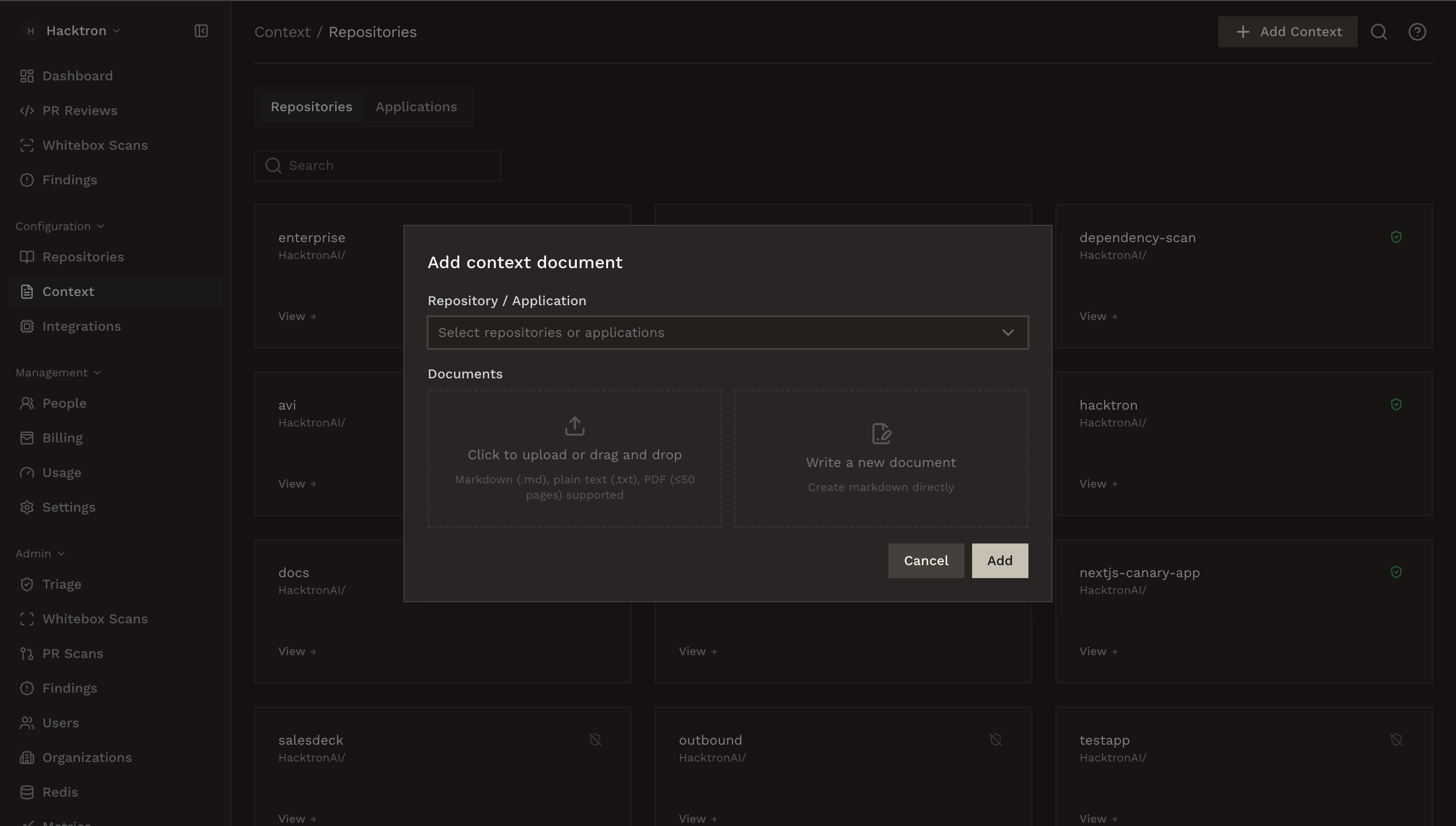
    On the **Context** page, select **Add Context**.
  </Step>

  <Step title="Choose a target">
    <p>
      Select one or more repositories or applications.
    </p>

    <p>
      Repository context is tied to those specific repositories. Application
      context is tied to an **application**, which can contain multiple repositories.
    </p>

    <Tip>
      You can [add a new application](/platform/context/applications#create-an-application) in the **Applications** tab.
    </Tip>

    <img src="https://mintcdn.com/hacktronai/8mhZfNLmjZwEnk7Y/images/context_add_document.png?fit=max&auto=format&n=8mhZfNLmjZwEnk7Y&q=85&s=518fd37095944d5c6292526b5a7f825b" alt="The Add context document dialog" width="3024" height="1716" data-path="images/context_add_document.png" />
  </Step>

  <Step title="Upload or create documents">
    Drag in a file, or choose **Create a document** to write Markdown directly.
  </Step>

  <Step title="Add">
    Select **Add**. The document is saved and queued for the threat model.
  </Step>

  <Step title="Sync context">
    Go to the repository or application context page and select **Regenerate**.
    This updates the threat model with the new context.
  </Step>
</Steps>

### Manage documents

Open a repository or application to see its documents in the left sidebar.
From there you can view a document, download a PDF, edit Markdown inline, see past versions in the **History** tab, or remove a document you no longer need.

<Tip>
  Keep context durable. Prefer stable security assumptions, architecture, data
  ownership, and trust boundaries that are not likely to change frequently.
</Tip>

## Automatically generated context

Hacktron creates some context on its own:

* **After application creation**: if every repository in the new application already has a threat model, Hacktron can generate the application threat model in the background.
* **After feedback**: repeated triage signals, especially false positives and accepted risks, are folded into the repository threat model over time.
* **Before a White-box Pentest**: if a scanned application or repository does not have a threat model yet, Hacktron will bootstrap one before the scan.
* **Manual sync**: when you upload or remove context documents, you can manually regenerate the threat model.

## Next steps

<Columns cols={2}>
  <Card title="Applications" icon="layer-group" href="/platform/context/applications">
    Create application groupings for related repositories.
  </Card>

  <Card title="Threat models" icon="shield-check" href="/platform/context/threat-models">
    Understand how Hacktron generates and updates threat models.
  </Card>
</Columns>
